
Porre fine alla guerra di Trump e Netanyahu in Medio Oriente
Se non verrà fermata presto, questa guerra potrebbe facilmente trasformarsi in una conflagrazione globale, diventando a tutti gli effetti la Terza Guerra Mondiale
di Jeffrey D. Sachs (Sybil Fares Common Dreams, 16/3/2026)

La guerra di Israele e Stati Uniti contro l’Iran sta travolgendo l’intero Medio Oriente e potrebbe degenerare in un conflitto mondiale. Le conseguenze economiche sono già gravi e potrebbero diventare catastrofiche. Lo Stretto di Hormuz convoglia circa un quinto di tutto il petrolio scambiato a livello globale e il 30% del GNL mondiale. Una chiusura prolungata dello Stretto scatenerebbe uno shock energetico senza precedenti nell’era moderna.
È probabile che il conflitto vada fuori controllo perché gli Stati Uniti e Israele sono determinati a ottenere l’egemonia nel mondo arabo e nell’Asia occidentale — un’egemonia che combina l’espansione territoriale israeliana con il controllo dei regimi dell’intera regione sostenuto dagli americani. L’obiettivo finale è una “Grande Israele” che assorba tutta la Palestina storica, insieme a governi arabi e islamici compiacenti e privati della loro reale sovranità, incluse le scelte su come e dove esportare il proprio petrolio e gas. Questo è folle. Nessun paese della regione vuole che Israele agisca indisturbato come sta facendo, uccidendo civili in tutta l’area, distruggendo Gaza e la Cisgiordania, invadendo il Libano, colpendo l’Iraq e lo Yemen e bombardando a tappeto Teheran.
Nessun paese vuole che le proprie esportazioni di idrocarburi siano sotto l’effettivo controllo statunitense. La guerra finirà se, e solo se, il disgusto globale per l’aggressione di Stati Uniti e Israele costringerà questi paesi a fermarsi. In caso contrario, è probabile che vedremo il Medio Oriente in fiamme e il mondo in una crisi energetica ed economica senza precedenti nella storia moderna.
La guerra potrebbe facilmente trasformarsi in una conflagrazione globale, diventando a tutti gli effetti la Terza Guerra Mondiale.
Eppure, esiste un’alternativa. La guerra potrebbe fermarsi su basi razionali se Israele e gli Stati Uniti venissero chiamati a rispondere delle proprie azioni in modo deciso dal resto del mondo. Porre fine al conflitto richiede una serie di passaggi interconnessi per garantire la sicurezza di base a tutte le parti e, di fatto, al mondo intero.
L’Iran ha bisogno di una fine permanente dell’aggressione di Stati Uniti e Israele. I paesi del Golfo hanno bisogno che cessino i raid ritorsivi dell’Iran. I Palestinesi hanno bisogno di uno Stato indipendente. Israele ha bisogno di una sicurezza duratura e del disarmo di Hamas e Hezbollah. Il mondo intero ha bisogno dell’apertura dello Stretto di Hormuz e di un monitoraggio internazionale del programma nucleare iraniano per garantire che esso rispetti il Trattato di non proliferazione nucleare, come l’Iran stesso afferma di voler fare. E tutti i paesi vogliono, o dovrebbero volere, una reale sovranità per se stessi e per la propria regione.
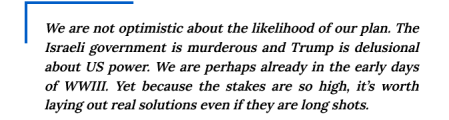
Non siamo ottimisti riguardo alle probabilità di successo del nostro piano. Il governo israeliano è spietato e Trump si illude riguardo al potere degli Stati Uniti. Forse siamo già ai primi giorni della Terza Guerra Mondiale. Eppure, poiché la posta in gioco è così alta, vale la pena proporre soluzioni concrete, anche se sono scommesse azzardate.
La sicurezza collettiva potrebbe essere raggiunta attraverso cinque misure interconnesse.
In primo luogo, gli Stati Uniti e Israele dovrebbero porre immediatamente fine alla loro aggressione armata in tutta la regione e ritirare le proprie forze.
In secondo luogo, l’Iran dovrebbe interrompere i suoi attacchi ritorsivi in tutti i paesi del CCG (Consiglio di Cooperazione del Golfo) e sottoporsi nuovamente al monitoraggio dell’Agenzia Internazionale per l’Energia Atomica (AIEA) nell’ambito di un Piano d’Azione Congiunto Globale (JCPOA) revisionato, che il Presidente Trump ha incoscientemente abbandonato nel 2018.
Terzo, lo Stretto di Hormuz verrebbe riaperto con il reciproco accordo tra Iran e CCG.
Quarto, la soluzione a due stati verrebbe immediatamente attuata ammettendo la Palestina come Stato membro a pieno titolo delle Nazioni Unite. A Israele verrebbe richiesto di porre fine all’occupazione della Cisgiordania e di Gerusalemme Est e di ritirare le proprie forze dal Libano e dalla Siria.
Quinto, il riconoscimento ONU dello Stato di Palestina costituirebbe la base per un disarmo regionale globale di tutti gli attori non statali, verificato sotto monitoraggio internazionale.
Il risultato finale sarebbe un ritorno al diritto internazionale e alla Carta delle Nazioni Unite.
Chi vincerebbe in questo piano? I popoli della regione, di Israele, Palestina, Libano, Siria, Iraq, Iran e del resto del mondo.
Chi perderebbe? Solo i sostenitori della “Grande Israele”, guidati da Benjamin Netanyahu, Itamar Ben-Gvir, Bezalel Smotrich e Mike Huckabee, che hanno portato il mondo sull’orlo della distruzione.
Ecco i cinque passaggi più nel dettaglio.
Primo: Porre fine all’aggressione armata USA-Israele. Israele e gli Stati Uniti dovrebbero interrompere la loro aggressione e ritirare le proprie forze. In cambio, l’Iran cesserebbe i suoi attacchi ritorsivi. Questo non sarebbe un semplice cessate il fuoco, bensì il primo passo di un accordo di pace globale e di un sistema di sicurezza collettiva.
Secondo: Ritorno al JCPOA. La questione nucleare verrebbe risolta attraverso un rigoroso monitoraggio da parte dell’AIEA, non tramite campagne di bombardamenti che finiscono solo per sottrarre l’uranio arricchito dell’Iran al controllo internazionale. Il Consiglio di Sicurezza dell’ONU ripristinerebbe immediatamente il quadro di base del JCPOA del 2015, in base al quale l’Iran deve rispettare rigorosamente il monitoraggio dell’AIEA e i limiti concordati per il suo programma nucleare, mentre verrebbero revocate le sanzioni economiche contro l’Iran.
Terzo: Riaprire lo Stretto di Hormuz in un quadro Iran-CCG. Lo Stretto di Hormuz verrebbe riaperto rapidamente, con il passaggio sicuro garantito congiuntamente da Iran e CCG. I paesi del CCG rivendicherebbero la sovranità sulle basi militari nei loro territori per garantire che queste non vengano utilizzate come rampe di lancio per nuovi attacchi offensivi contro l’Iran.
Quarto: La soluzione a due stati. La soluzione a due stati verrebbe attuata ammettendo la Palestina all’ONU come 194° Stato membro permanente. Ciò non richiede altro che la revoca del veto da parte degli Stati Uniti. La statualità palestinese è conforme al diritto internazionale e all’Iniziativa di pace araba, sul tavolo dal 2002. In cambio, i paesi della regione stabilirebbero relazioni diplomatiche con Israele e il Consiglio di Sicurezza dell’ONU invierebbe forze di peacekeeping per garantire la sicurezza sia della Palestina che di Israele.
Quinto: Fine della belligeranza armata. In concomitanza con la soluzione a due stati, ogni belligeranza armata nella regione cesserebbe immediatamente, includendo il disarmo di Hamas, Hezbollah e altri attori armati non statali. Nel caso della Palestina, il disarmo di Hamas sosterrebbe l’autorità dello Stato Palestinese. Nel caso del Libano, il disarmo di Hezbollah ripristinerebbe la piena sovranità del Paese, con le Forze Armate Libanesi come unica autorità militare. Il disarmo verrebbe verificato da osservatori internazionali e garantito dal Consiglio di Sicurezza dell’ONU. Il punto chiave è che la guerra tra Israele e Stati Uniti contro l’Iran non è avvenuta nel vuoto. La strategia “Clean Break“, sviluppata da Netanyahu e dai suoi sostenitori neocon americani nel 1996 e attuata da allora, prevede che Israele stabilisca l’egemonia nella regione attraverso guerre di cambio di regime, con gli Stati Uniti come partner esecutivo. Come rivelato dal Comandante Supremo della NATO Wesley Clark dopo l’11 settembre, gli Stati Uniti hanno elaborato piani un quarto di secolo fa per rovesciare i governi di sette paesi: “iniziando con l’Iraq, e poi Siria, Libano, Libia, Somalia, Sudan e, per finire, l’Iran“. Stiamo quindi vivendo il culmine di un piano di lunga data di Israele e Stati Uniti per dominare il mondo arabo e l’Asia occidentale, creare una Grande Israele e bloccare permanentemente la statualità palestinese. Non siamo ottimisti sulle probabilità del nostro piano. Il governo israeliano è sanguinario e Trump si illude sul potere degli Stati Uniti. Siamo forse già nei primi giorni della Terza Guerra Mondiale. Eppure, poiché la posta in gioco è così alta, vale la pena proporre soluzioni reali anche se sono scommesse azzardate. Crediamo tuttavia che il mondo non occidentale — la parte che non è costituita da stati vassalli del potere statunitense — comprenda l’urgenza della pace e della sicurezza. Chi, dunque, potrebbe farsi promotore di un piano di pace a cui gli Stati Uniti e Israele si opporranno con ogni mezzo a loro disposizione, finché il peso dell’opposizione globale e della catastrofe economica non lascerà loro altra scelta se non quella di accettarlo? Esiste un gruppo principale, ed è quello delle nazioni BRICS. Brasile, Russia, India, Cina, Sud Africa e l’adesione allargata del blocco, che ora include Emirati Arabi Uniti, Iran, Egitto, Etiopia e Indonesia, rappresentano circa metà della popolazione mondiale e oltre il 40% del PIL globale (rispetto al 28% dei tanto decantati ma sopravvalutati paesi del G7). I BRICS hanno la credibilità, il peso economico e l’assenza di complicità storica nell’imperialismo mediorientale per riportare il mondo alla ragione. I BRICS dovrebbero convocare un vertice d’emergenza e presentare un quadro unificato che incorpori le condizioni per la pace e la sicurezza, che a sua volta verrebbe spinto al Consiglio di Sicurezza dell’ONU. Lì, l’opinione pubblica mondiale direbbe agli Stati Uniti e a Israele di smettere di spingere il mondo verso la catastrofe e ricorderebbe a tutti i paesi di aderire alla Carta delle Nazioni Unite.
Ending the Trump-Netanyahu War in the Middle East
If not stopped soon, this war could easily turn into a global conflagration, effectively into World War III
by Jeffrey D. Sachs ( Sybil Fares Common Dreams, Mar 16, 2026)
The Israel-US war on Iran is engulfing the entire Middle East and could escalate to global war. The economic consequences are already severe and could become catastrophic. The Strait of Hormuz carries approximately one-fifth of all oil traded globally, and 30 percent of the world’s LNG. A sustained closure of the Strait would trigger an energy shock without modern precedent.
The conflict is likely to spiral out of control because the US and Israel are dead set on hegemony in the Arab world and West Asia – one that combines Israeli territorial expansion with American-backed regime control across the region. The ultimate goal is a Greater Israel that absorbs all historic Palestine, combined with compliant Arab and Islamic governments stripped of genuine sovereignty, including on choices as to how and where they export their oil and gas.
This is delusional. No country across the region wants Israel to run wild as it is doing, murdering civilians across the entire region, destroying Gaza and the West Bank, invading Lebanon, striking Iraq and Yemen, and carpet-bombing Tehran. No country wants its hydrocarbon exports under effective US control. The war will end if and only if global revulsion at US and Israeli aggression force these countries to stop. Short of that, we are likely to see the Middle East in flames and the world in an energy and economic crisis unprecedented in modern history. The war could easily turn into a global conflagration, effectively into World War III.
Yet, there exists an alternative. The war could stop on rational grounds if Israel and the US are decisively called to account by the rest of the world. Ending the war requires a set of interlinked steps to provide basic security for all parties, and indeed for the world. Iran needs a permanent end to the US-Israel aggression. The Gulf countries need an end to Iran’s retaliatory strikes. The Palestinians need an independent state. Israel needs lasting security and the disarmament of Hamas and Hezbollah. The whole world needs the opening of the Strait of Hormuz, and international monitoring of Iran’s nuclear program to ensure it abides by the Nuclear Non-Proliferation Treaty, as Iran says it wants to do. And all countries want, or should want, real sovereignty for themselves and their region.
Collective security could be achieved in five interconnected measures. First, the US and Israel would immediately end their armed aggression across the entire region and withdraw their forces. Second, Iran would stop its retaliatory strikes across the GCC and resubmit to monitoring by the International Atomic Energy Agency under a revised Joint Comprehensive Plan of Action (JCPOA), which President Trump recklessly abandoned in 2018. Third, the Strait of Hormuz would reopen with mutual agreement of Iran and the GCC. Fourth, the two-state solution would be immediately implemented by admitting Palestine as a full member state of the UN. Israel would be required to end its occupation of the West Bank and East Jerusalem and to withdraw its forces from Lebanon and Syria. Fifth, the UN recognition of the State of Palestine would form the basis for a comprehensive regional disarmament of all non-state actors, verified under international monitoring. The end result would be a return to international law and the UN Charter.
Who would win in this plan? The people of the region, of Israel, Palestine, Lebanon, Syria, Iraq, Iran, and the rest of the world. Who would lose? Only the backers of Greater Israel, led by Benjamin Netanyahu, Itamar Ben-Gvir, Bezalel Smotrich, and Mike Huckabee, who have brought the world to the brink of destruction.
Here are the five steps in more detail.
First: End the US-Israeli Armed Aggression.
Israel and the US would stop their aggression and withdraw their forces. In turn, Iran would cease its retaliatory strikes. This would not be a mere ceasefire. Rather, it would be the first step of an overall peace agreement and collective security arrangement.
Second: Return to the JCPOA.
The nuclear question would be resolved through strict monitoring by the International Atomic Energy Agency, not through bombing campaigns that merely put Iran’s enriched uranium beyond international monitoring. The UN Security Council would immediately reinstate the basic framework of the 2015 Joint Comprehensive Plan of Action (JCPOA), under which Iran must strictly comply with IAEA monitoring and agreed limits on its nuclear program, while economic sanctions on Iran would be lifted.
Third: Reopen the Strait of Hormuz in an Iran-GCC Framework
The Strait of Hormuz would be quickly reopened, with safe passage jointly guaranteed by Iran and the GCC. The GCC countries would assert sovereignty over the military bases in their countries to ensure that the bases would not be used as launchpads for renewed offensive strikes against Iran.
Fourth: The Two-State Solution.
The two-state solution would be implemented, by admitting Palestine into the UN as the 194th permanent member state. This requires nothing more than the US lifting its veto. Palestinian statehood is in accord with international law and with the Arab Peace Initiative, which has been on the table since 2002. In turn, the countries in the region would establish diplomatic relations with Israel, and the UN Security Council would introduce peacekeepers to ensure the security of both Palestine and Israel.
Fifth: An End to Armed Belligerency.
In conjunction with the two-state solution, all armed belligerency in the region would end forthwith, including the disarmament of Hamas, Hezbollah, and other armed non-state actors. In the case of Palestine, the disarmament of Hamas would underpin the authority of the Palestinian state. In the case of Lebanon, the disarmament of Hezbollah would restore Lebanon’s full sovereignty, with the Lebanese Armed Forces as the sole military authority in the country.
The disarmament would be verified by international monitors and guaranteed by the UN Security Council.
The key point is that the Israel-US war on Iran has not occurred in a vacuum. The Clean Break strategy, developed by Netanyahu and his American neocon backers in 1996, and implemented since then, calls for Israel to establish hegemony in the region through wars of regime change, with the US as the implementing partner. As NATO Supreme Commander Wesley Clark revealed after 9/11, the US drew up plans a quarter century ago to overthrow governments in seven countries: “starting with Iraq, and then Syria, Lebanon, Libya, Somalia, Sudan and, finishing off, Iran.” We are therefore living through the culmination of a long-standing plan by Israel and the US to dominate the Arab world and West Asia, create a Greater Israel, and permanently block Palestinian statehood.
We are not optimistic about the likelihood of our plan. The Israeli government is murderous and Trump is delusional about US power. We are perhaps already in the early days of WWIII. Yet because the stakes are so high, it’s worth laying out real solutions even if they are long shots. We do believe, however, that the non-Western world—the part that is not vassal states to US power—understands the urgency of peace and security.
Who, then, could champion a peace plan that the US and Israel will resist with every means at their disposal, until the weight of global opposition and economic catastrophe leaves them no choice but to accept it?
There is one main group, and that is the BRICS nations.
Brazil, Russia, India, China, South Africa, and the bloc’s expanded membership, which now includes the UAE, Iran, Egypt, Ethiopia, and Indonesia, represent approximately half of the world’s population and more than 40 percent of global GDP (compared to 28 percent for the vaunted but overblown G7 countries). The BRICS have the credibility, the economic weight, and the absence of the historical complicity in Middle East imperialism to bring the world to its senses. The BRICS should convene an emergency summit and present a unified framework incorporating the conditions for peace and security, which in turn would be pressed at the UN Security Council. There, world opinion would tell the US and Israel to stop pushing the world towards catastrophe, and would remind all countries to adhere to the UN Charter.











 cambiailmondo
Lascia un commento